TL;DR: For water damage in Talent, OR, call a restoration company first if the water source is already stopped. Call Swept Away Restoration at (541) 821-3664 for 24/7 extraction and drying, call a plumber if water is still actively flowing from a pipe or fixture, call 911 or your utility for electrical or gas hazards, and call your insurer after mitigation starts so you have photos and a documented timeline to support the claim.
If you just walked into a flooded living room in Talent and you’re standing there with a phone in your hand not sure who gets the first call, you’re not alone. Most homeowners have never had to make this decision before, and the order matters: call the wrong person first and you lose hours while water keeps soaking into drywall and subfloor along Bear Creek and Wagner Creek neighborhoods where many Rogue Valley homes sit close to grade.
Who Should You Call First for Water Damage in Talent?
Call Swept Away Restoration at (541) 821-3664 as soon as the water source is stopped or contained. The company is an IICRC Certified Firm, holds Oregon license #242626, and runs a 24/7 line, so a call placed at 2 a.m. still reaches someone who can walk you through immediate steps and get a crew moving.
If water is still actively running, flowing, or spraying (a supply line that hasn’t been shut off, a water heater still leaking), your first call is whoever can stop it: the main shutoff valve yourself if you know where it is, or a plumber if you don’t. Restoration work on a loss that’s still getting worse is just chasing a moving target.
Once the source is off, extraction and drying become the time-sensitive part. Materials left wet longer than 24 to 48 hours start growing mold, according to the EPA, so the restoration call usually comes before the insurance call, not after.
Plumber, Insurer, or Restoration Company: What’s the Right Order?
The order is source, safety, restoration, then insurer, in that sequence. Mixing it up is the single biggest reason claims get complicated or losses get worse.
- Stop the source. Shut off the water at the fixture or the main if you can do it safely. If you can’t locate the shutoff or the leak is from a slab or wall you can’t access, that’s a plumber call.
- Check for hazards. Standing water near an outlet or panel, a sagging ceiling, or any gas smell means you get everyone out and call 911 or the utility company first. No restoration crew will work a space that isn’t safe to enter.
- Call the restoration company. This is the step most people skip or delay, and it’s the one that actually protects the property. Extraction, moisture mapping, and structural drying equipment need to go in while the damage is still fresh, not after you’ve spent a day waiting on an adjuster callback.
- Call your insurer with documentation in hand. Photograph the damage before anything is moved or cleaned, note the time you noticed the problem, and keep any receipts. Most homeowners policies cover sudden, accidental water damage, like a burst supply line, but typically exclude gradual leaks and wear and tear, per the Insurance Information Institute. A restoration company’s documentation (photos, moisture readings, a written scope) is exactly what an adjuster needs to process the claim.
For a fuller walkthrough of that first day, see what to do in the first 24 hours after water damage.
What If Your Whole House Flooded, Not Just One Room?
A whole-house flood is a different call than a single leaking fixture, because the water itself may be a different category. Clean water from a burst supply line (Category 1) can be handled with standard extraction and drying. Water from outside the home, like Bear Creek overflow or wind-driven storm rain pushing in around windows and foundations, is classified as Category 3 (black water) under the IICRC S500 standard and requires contaminated-material removal, not just drying.
If the water came from a sewer or drain backup anywhere beyond the trap, treat that the same way, as Category 3, regardless of how it looks. That changes what gets removed, what gets treated, and what PPE the crew wears on site. It also changes your insurance picture: standard homeowners policies generally don’t cover sewer backup or sump pump failure unless you’ve added a water backup endorsement, so check your policy before assuming it’s covered.
Either way, a flooded house means more extraction equipment and a longer drying timeline than a single wet room, so the restoration call becomes more urgent, not less.
What Are the Signs You Need Professional Water Extraction (Not Just Towels)?
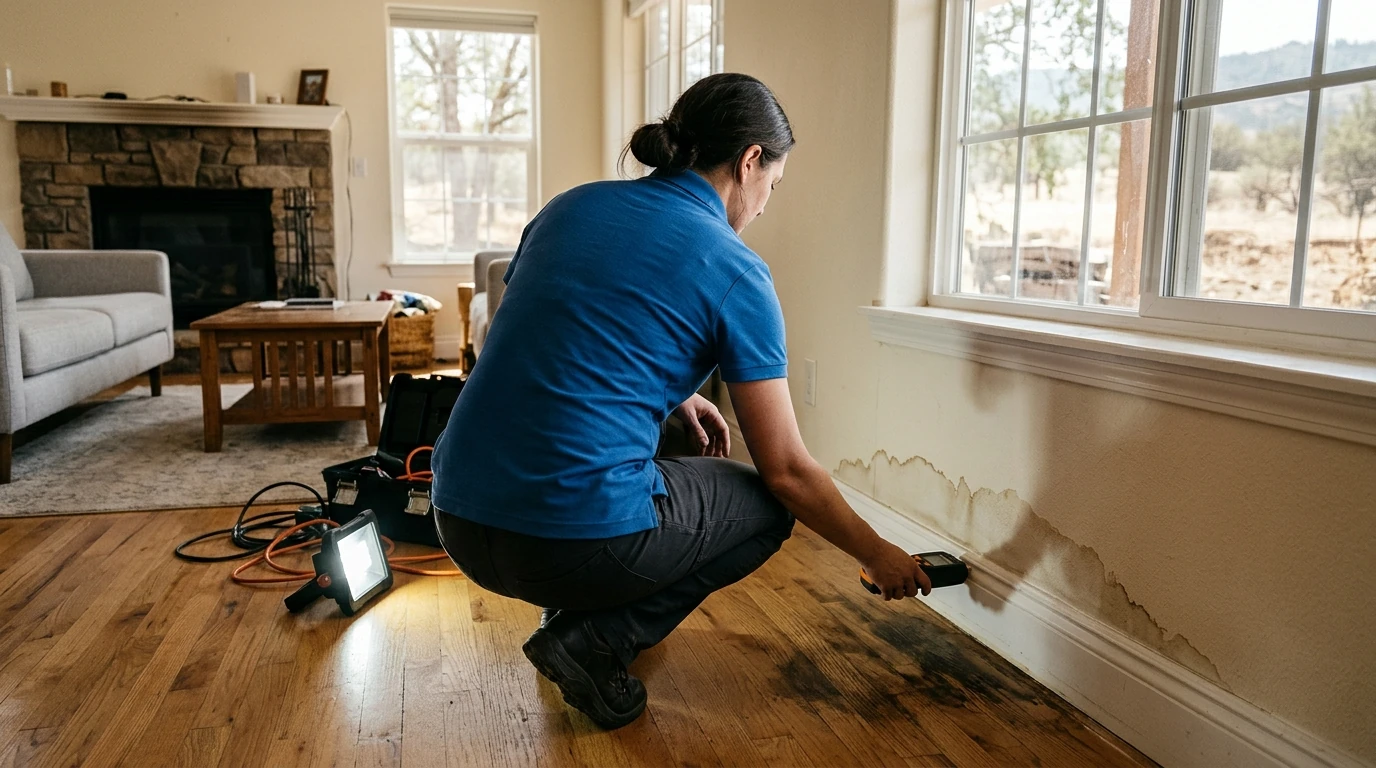
You need professional extraction once water has soaked past the surface into subfloor, drywall, or insulation, which towels and a shop vac can’t reach. A moisture meter reading inside a wall or under flooring is the only reliable way to know how far water has traveled.
Other signs it’s past a DIY job: standing water deeper than about a quarter inch across a room, water that’s been sitting more than a few hours, any water that touched carpet padding or particle board subfloor (both wick and hold moisture), or a musty smell starting within a day. Baseboards that feel soft, paint that’s bubbling, or a floor that feels spongy underfoot are all signs water has already gotten into the structure.
If any of that describes what you’re looking at, the mopping-and-fans approach will dry the surface while leaving the real moisture trapped behind it, which is exactly the setup for hidden mold later.
What Happens When You Call a Water Damage Company in Talent?
The first call is a short intake: what happened, when, what’s wet, and whether anyone is on site. Have your address, a rough sense of how much water and how long it’s been sitting, and your insurance info ready if you have it.
On arrival, the crew checks for safety hazards, confirms the water source is stopped, and uses moisture meters and sometimes thermal imaging to map exactly how far the water traveled, often further than it looks from the surface. From there they set up extraction equipment to pull standing water, then position air movers and dehumidifiers sized to the affected square footage. Photos and moisture readings get logged throughout, which becomes the documentation your insurer will ask for.
Call Swept Away Restoration at (541) 821-3664 once the source is stopped and it’s safe to do so. Earlier is better; every hour of standing water adds drying time and risk on the back end.
About Swept Away Restoration
Swept Away Restoration is an IICRC Certified Firm (Oregon license #242626) founded in 2018, serving Ashland, Talent, and the surrounding Rogue Valley from offices in Ashland and Talent. The company handles water damage restoration, water cleanup, sewage cleanup, mold remediation, fire and smoke damage restoration, storm damage, biohazard cleanup, and reconstruction, with crews trained to IICRC water, structural drying, and mold standards and a 24/7 emergency line.
Video Transcript
You just walked into a flooded living room in Talent, Oregon, and you’re standing there holding your phone, wondering who to call first. Call Swept Away Restoration at 541-821-3664 once the water source is stopped. They’re IICRC certified and answer 24/7. If water is still actively flowing from a pipe or fixture, shut off the main valve yourself or call a plumber first. Standing water near outlets, a sagging ceiling, or any gas smell means everyone leaves and you call 911 or your utility. Once it’s safe, your contractor can start extraction and moisture mapping before mold has a chance to take hold. Photograph the damage, note the time you noticed it, and call your insurer after mitigation begins to support your claim. A whole-house flood from Bear Creek overflow or a sewer backup is treated differently, since contaminated water needs special removal, not just drying equipment. Soft baseboards, bubbling paint, or a spongy floor mean water has already soaked into the structure, not just the surface. A quick call gets your contractor moving fast, with extraction and drying equipment that pulls trapped moisture out of walls, floors, and subfloor. Don’t wait for water to spread further. Call Swept Away Restoration at (541) 821-3664 to schedule an assessment.